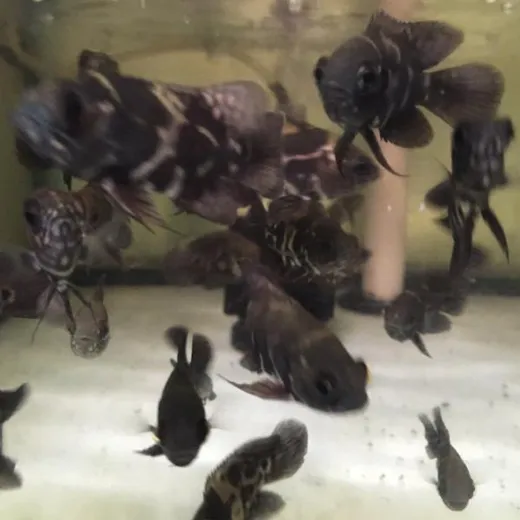
Wild Zebra Oscar
In the wilds of the Amazon River basin, the actual wild oscar is black with some white, hence the name zebra oscar. These oscars are less common than the tank-raised tiger and red oscars. Wild oscars are active and hardy and share the same characteristics as the aquarium-bred varieties. When larger, wild oscars get a bold red dot on the tail.
Quick Facts
| Scientific Name | Astronotus ocellatus (wild type) |
|---|---|
| Origin | Amazon basin, South America |
| Care Level | Easy to moderate |
| Temperament | Semi-aggressive; eats smaller fish |
| Adult Size | Up to 12–14″ |
FAQ
What makes wild zebra oscars different from other oscar varieties?
Wild zebra oscars are naturally black with white markings, unlike the red or tiger oscars commonly found in aquariums. They originate from the Amazon basin and exhibit a bold red dot on the tail when mature.
Are wild zebra oscars suitable for beginners?
Wild zebra oscars have an easy to moderate care level, making them accessible to experienced hobbyists. However, their semi-aggressive nature and tendency to eat smaller fish require a well-planned tank setup.
How big do wild zebra oscars grow?
They can grow up to 12–14 inches in adult size, so a large tank is necessary to accommodate their size and active behavior.
Angela White –
Received my wild zebra oscar in good condition. It’s active and curious, showing the natural black and white pattern. The red dot on its tail is quite striking when it matures. Needs a spacious tank, but it’s a unique addition to any aquarium.
Christopher Buckland –
The fish looks exactly like the description—black with white stripes. It’s more active than other oscars I’ve had. I’ve had to remove a few small fish to avoid feeding conflicts. Overall, a fascinating species.
William Russell –
This is the first time I’ve kept a wild oscar. It’s very healthy and shows strong swimming behavior. The red tail spot appears clearly after a few months. I recommend it for those who want a natural, wild-looking fish.