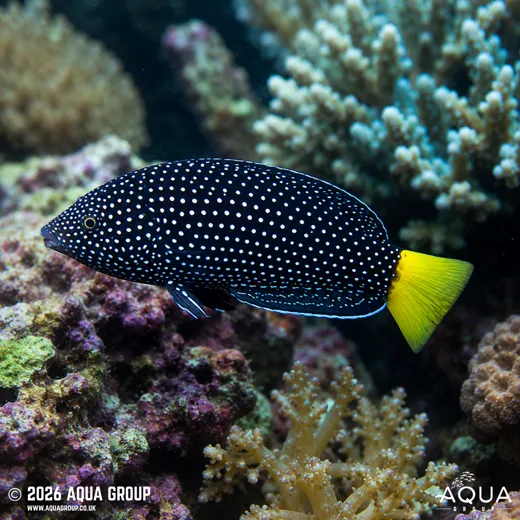
Yellowtail Tamarin Wrasse
A dark-bodied wrasse covered in fine white spots with a brilliant yellow tail. Beautiful, and among the harder wrasses to establish.
Feeding
Carnivorous, picking tiny invertebrates from rock and sand. Needs frozen mysis and enriched brine shrimp several times daily, plus a mature tank with a live pod population.
Compatibility
Reef safe with corals but hunts small invertebrates. Peaceful toward fish and easily outcompeted at feeding time.
Behaviour and personality
Picks constantly at rock and sand. Buries in the sand bed to sleep. Juveniles are dark with white spots; adult females develop a bright yellow tail.
Before you buy
Like all tamarin wrasses this species ships badly and often arrives underweight. It needs a mature system with abundant live rock and a well-established ecosystem to thrive.
| Specs | Details |
|---|---|
| Species | Yellowtail Tamarin Wrasse |
| Origin | Indo-Pacific |
| Size (adult) | 4-6 inches |
| Temperature | 75-82°F |
| Water pH | 8.1-8.4 |
| Water hardness | 8-12 dGH |
FAQ
What kind of diet does the Yellowtail Tamarin Wrasse require?
It is carnivorous and requires frozen mysis and enriched brine shrimp several times a day. A mature tank with a live rock population is essential to support its feeding habits.
Is the Yellowtail Tamarin Wrasse safe for a reef tank?
Yes, it is reef safe with corals, but it hunts small invertebrates. It should not be kept with vulnerable invertebrates.
How does the behavior of the wrasse change as it matures?
Juveniles are dark with white spots. Adult females develop a bright yellow tail and are active, constantly picking at rock and sand, often burying themselves in the sand bed to sleep.

Melanie Cameron –
The wrasse arrived in good condition after a few weeks in the tank. It’s active and curious, spends time digging in the sand, and has started to show its yellow tail. Feeding it mysis and brine shrimp daily keeps it healthy. Needs a mature tank though, so patience is required.
Elizabeth Blake –
It’s a striking fish with a beautiful coloration. I’ve had it for two months now and it’s adapted well to the tank. It’s peaceful with other fish but does eat small invertebrates, so I removed a few sensitive ones. Feeding is a daily task but worth it.
Mary Watson –
The fish arrived underweight and seemed weak at first. After a month in a mature tank with live rock, it started to thrive. Still, it’s not easy to establish and requires consistent feeding and a stable environment.