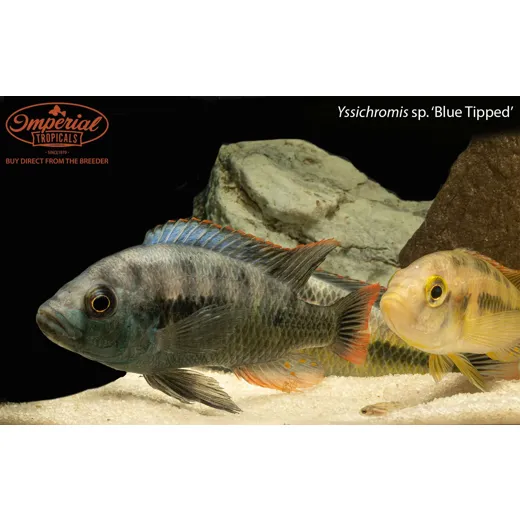
Yssichromis sp. ‘Blue Tipped’
Remarks: The Yssichromis sp. ‘blue tipped’ males turn solid blue/black with red and orange edges on their unpaired fins and golden egg spots on the anal fin. Outside of spawning, the fish are metallic-green with a gray undertone as seen in our photo – still a very pretty species! These fish are considered by many experts to be endangered in Lake Victoria. They are on the CARES list and we recommend any customers who buy this fish try to breed them. Yssichromis sp. ‘blue tipped’ will rarely exceed 4-5″ in length, however larger males do occasionally show up.
Scientific Name: Yssichromis sp. ‘Blue Tipped’
Common Name: Yssichromis sp. ‘Blue Tipped’
| Specimen Details | Features |
|---|---|
| Sex | Males show distinct coloration during spawning |
| Size | Rarely exceeds 4-5 inches; larger males occasionally appear |
| Coloration | Metalllic-green with gray undertone outside spawning; solid blue/black with red/orange fin edges and golden egg spots during spawning |
| Status | Endangered in Lake Victoria; listed on CARES |
FAQ
What is the typical size of Yssichromis sp. ‘Blue Tipped’?
The fish rarely exceeds 4-5 inches in length, though larger males do occasionally appear.
What color does this fish display during spawning?
During spawning, males turn solid blue/black with red and orange edges on unpaired fins and golden egg spots on the anal fin.
Is this species endangered?
Yes, Yssichromis sp. ‘Blue Tipped’ is considered endangered in Lake Victoria and is listed on the CARES list.

Carol Berry –
The fish arrived healthy and vibrant. I noticed the metallic green color when first setting up the tank. After a few weeks, one male developed the blue-black body with red edges on the fins. It’s a striking sight and I’m committed to breeding them to help conservation efforts.
Jake Nash –
Beautiful fish with unique color changes. The green phase is quite attractive, and the spawning coloration is impressive. I’ve been advised to breed them to support conservation, which I’m now actively doing.
Olivia Hunter –
This species is rare and visually stunning. The fish are active and show clear color shifts. I’ve kept them in a 55-gallon tank with compatible species and they’ve adapted well. I plan to breed them to contribute to preservation.